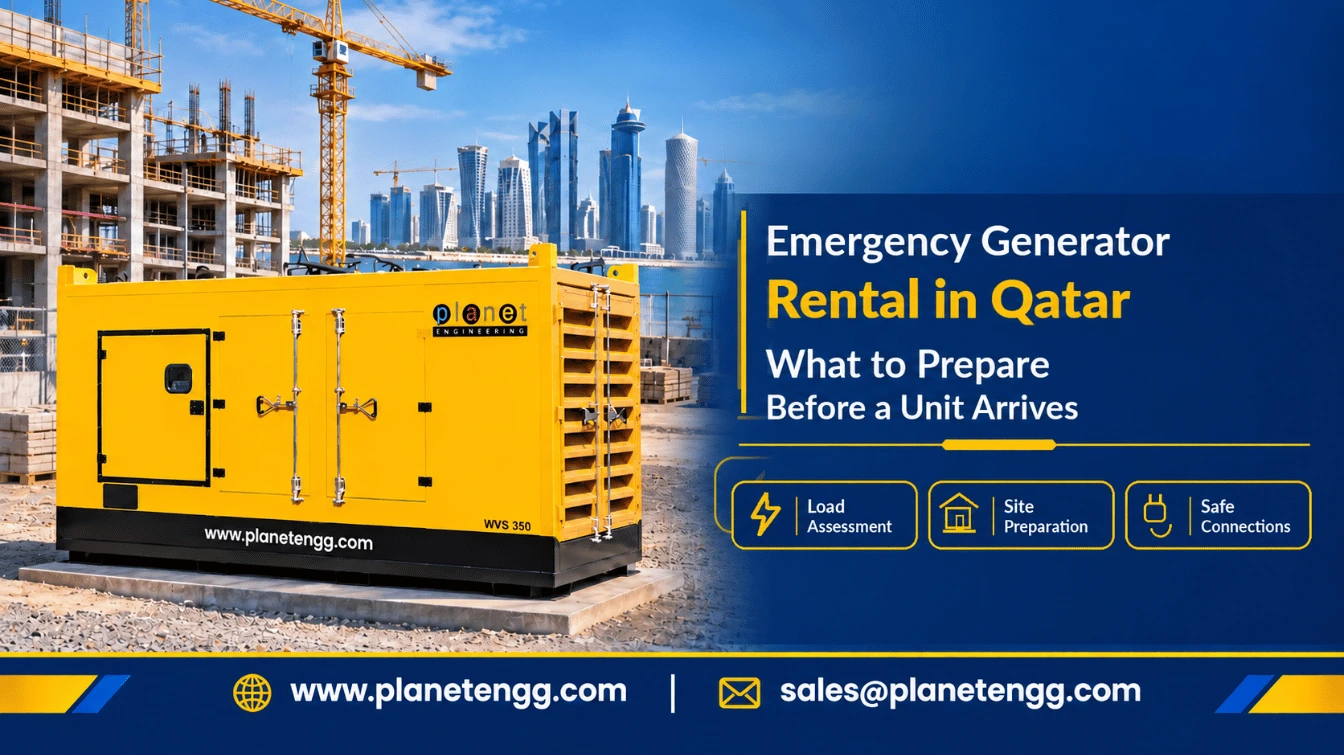
When the main supply fails, or a planned outage is approaching, the time between the call and a running generator depends heavily on the site. A rental generator can only be installed quickly if its location, connection point, fuel arrangement and load details are ready.
This guide sets out what to prepare before a rental unit arrives: the information that defines the power requirement, site and placement needs, a safe electrical connection, fuel and cooling considerations and the checks carried out on delivery. It is written for oil and gas support facilities, industrial sites and critical buildings, including facilities where building management system (BMS) controls and monitoring must stay online.
Define the power requirement
The rental team can recommend the right generator quickly when you can answer a few technical questions. Collect these before you call.
| Information | Why it matters |
|---|---|
| Total running load (kW) and the largest motor | Sets the generator rating and shows whether motor starting needs extra capacity |
| Voltage, number of phases and frequency | Must match the site supply, for example three-phase at 50 Hz; confirm the exact values on site |
| Essential and non-essential loads | Lets you size for critical loads only, such as control rooms, safety systems and BMS equipment |
| Expected run time | Drives fuel planning and servicing arrangements |
| Connection point and cable route | Determines cable length, type and terminations |
| Automatic or manual changeover | Decides whether a transfer switch is needed |
| Noise, emission or space limits | Influences the choice of enclosed or silenced units |
| Access route and permit requirements | Affects delivery, positioning and start-up time |
If you do not have an exact load figure, equipment nameplate data and recent maximum demand readings from the distribution board are a good starting point. A technical assessment then confirms a suitable rating.
Prepare the site for placement
A generator can only be installed quickly where the delivery vehicle can reach the placement area and the unit can run safely once it is there.
- Access: clear the delivery route and check height, width, gate and ground conditions. Arrange permits, escorts and any lifting equipment in advance.
- Ground: choose a firm, level surface that can support the unit’s weight, away from drainage paths and low-lying areas.
- Clearances: leave the manufacturer’s recommended space around the unit for airflow and service access and keep radiator air inlets and outlets unobstructed.
- Ventilation and exhaust: place the unit outdoors where exhaust gas cannot reach building air intakes, windows or work areas. Never run a generator in an enclosed space.
- Classified areas: at oil and gas sites, position the unit outside hazardous-area zones unless it is certified for them and follow the site’s permit-to-work system.
- Spill control: provide a drip tray or bund for fuel and oil, with a spill kit nearby.
- Protection: set up barriers against vehicle traffic, an exclusion zone around the unit, fire extinguishers and warning signs.
Plan the electrical connection safely
A qualified electrician must make the connection, following the site’s electrical procedures and permit system.
- Use an approved changeover arrangement. Never connect a generator to site distribution without an automatic transfer switch (ATS) or a changeover switch that prevents the generator and the mains from feeding the same circuit at once. Backfeeding the supply can endanger people working on the network.
- Identify the connection point: a spare breaker, changeover panel or generator inlet. Isolate, lock off and tag the circuit before work begins.
- Check the cabling: use cables of the correct rating and length, protect them from vehicles and heat and make sure the terminations suit the connection point.
- Confirm the earthing arrangement: the frame and neutral connection must suit the site’s earthing system, so confirm it with the site electrical engineer.
- Verify phase rotation before connecting motors so that they turn in the right direction.
- Plan load sequencing: switch on the largest loads first and add the rest in steps instead of all at once.
- Confirm control signals: decide which signals, such as generator running, fault and ATS position, must reach the BMS or control room.
Fuel, cooling and Qatar operating conditions
A rental generator that runs out of fuel or overheats is as unavailable as one that never arrived.
- Fuel supply: confirm the fuel type, storage arrangements and refuelling access. Ask the rental team for the expected fuel consumption at your load and plan refuelling well before the tank runs low. Follow site rules for fuel handling and never refuel a running or hot engine.
- Heat: Qatar’s high ambient temperatures reduce cooling margin, so keep airflow clear. Shading is useful only if it does not block air inlets and outlets or recirculate hot air.
- Dust and sand: keep air inlets clear and check the air filter regularly on longer hires.
- Humidity: inspect cable terminations and connections for moisture and corrosion.
- Monitoring: nominate someone to check the readings and alarms daily, including oil pressure, coolant temperature, voltage, frequency and fuel level.
Pre-arrival checklist
Work through this list before the unit is dispatched.
- Confirm the running load, largest motor, voltage, phases and frequency.
- Choose the connection point and arrange a qualified electrician.
- Confirm the changeover arrangement and isolate the circuit.
- Clear the delivery route, obtain permits and arrange escorts or lifting equipment.
- Prepare a firm, level placement area with the required clearances.
- Check ventilation, exhaust direction and distance from air intakes and classified areas.
- Arrange spill containment, fire extinguishers, barriers and warning signs.
- Arrange the fuel supply and a refuelling plan.
- Nominate a site contact and an operator for daily checks.
- Confirm which alarms and status signals must reach the BMS or control room.
On arrival: inspection and commissioning
A short, structured check when the unit is delivered prevents problems once the load is connected.
- Check the unit identification, general condition and any visible damage or leaks.
- Confirm fuel, coolant and oil levels, battery condition and controller status.
- Test the emergency stop and confirm that the controller is in the correct mode.
- Verify earthing, cable connections and phase rotation before applying load.
- Start the generator with no load and check voltage, frequency and gauge readings.
- Apply the load in steps, starting with the largest motors, and watch for alarms.
- Monitor temperature, oil pressure, voltage, frequency and fuel level at the start of the run.
- Record the readings, agree the refuelling and daily check routine, and confirm who to call if a fault appears.
Planet Engineering’s generator rental and support in Qatar
Planet Engineering is an certified provider of complete diesel generator solutions, with workshops and a parts center behind its rental fleet.
Generator rental
Diesel generators on hire from portable to industrial-grade units for projects, planned maintenance and emergency requirements, subject to technical assessment and availability.
Service, repair and maintenance
Preventive maintenance, servicing and repairs for industrial generators, with maintenance contracts available. See Engineering Services.
Parts and fuel system support
The Planet Parts Center supplies generator parts, filters and lubricants and the fuel injection calibration center supports engine performance.
Standby cover during repairs
A rental unit can supply temporary power while your own generator is in the workshop for service, repair or overhaul.
Permanent installations
For long-term requirements, Planet Engineering also supplies diesel generators from 25 kVA to 2500 kVA through its generator sales team.
Frequently asked questions
What information do I need before requesting an emergency rental generator?
Have the running load in kW, the largest motor, the voltage, phases and frequency, the expected run time, the connection point and the site location and access details ready. If a figure is unknown, equipment nameplate data is a good starting point.
How is the right generator rating chosen?
The rating depends on the running load, the starting demand of the largest motors, the duty and the site conditions. A technical assessment confirms the rating before the unit is dispatched.
Can a rental generator be connected directly to the site distribution board?
Only through an approved changeover arrangement, installed by a qualified electrician. A direct connection without a transfer switch can backfeed the supply and endanger people.
How often does a rental generator need refuelling?
It depends on the load, the tank capacity and the running hours. Ask for the expected fuel consumption at your load and plan refuelling before the level gets low.
Can a rental generator keep BMS and control systems online?
Yes, provided the essential circuits, including BMS and control equipment, are connected to the generator supply through a suitable changeover and the required status signals are agreed in advance.
Be ready before the unit arrives
A prepared site means a rental generator can be positioned, connected and loaded safely and without delay. Planet Engineering provides diesel generator rental, service, repair and parts support for industrial customers in Qatar.
To request a rental generator, call +974 4444 8200, message the rental team on WhatsApp (+974 3093 1303), or visit planetengg.com. Please have your load, voltage, location and run-time details ready.