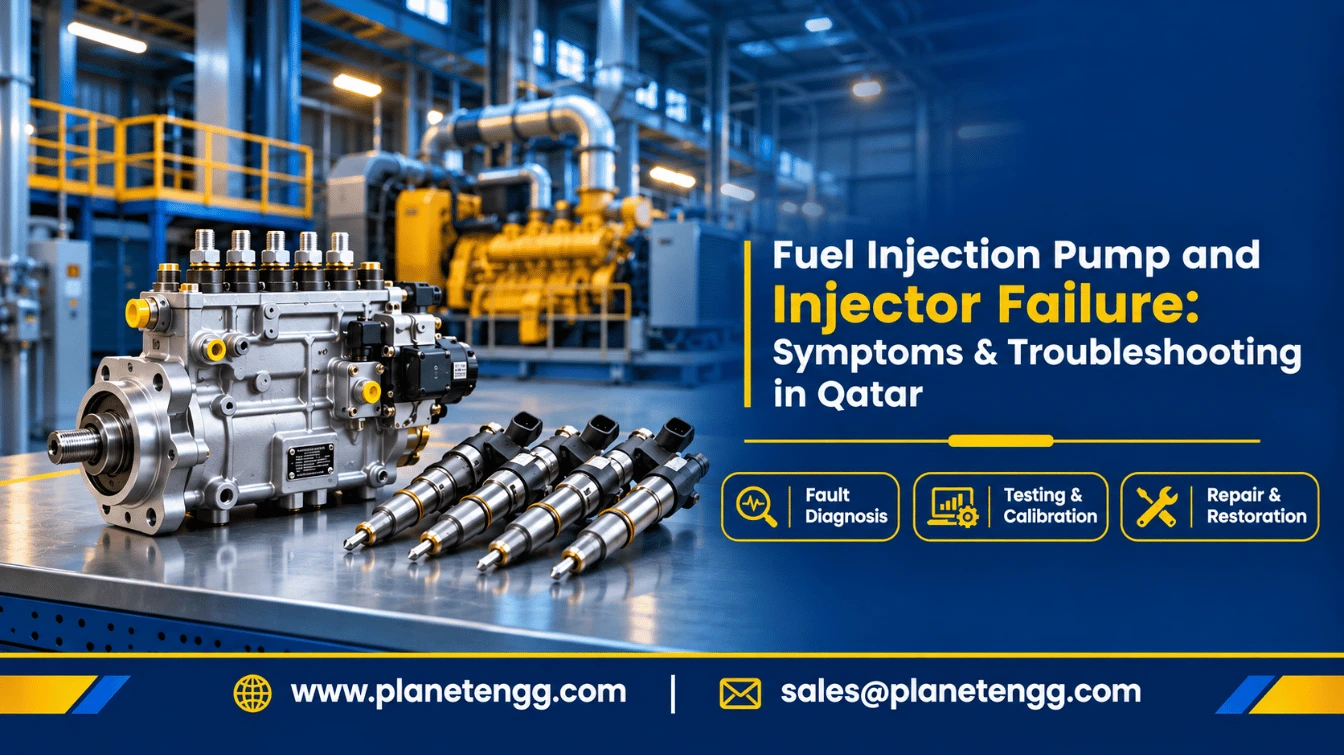
The fuel injection system meters, pressurises and delivers fuel to each cylinder at exactly the right moment and in exactly the right spray pattern. When the injection pump or an injector starts to wear or fail, the engine tells you quickly: it starts hard, smokes, loses power or runs unevenly.
For generators, pumps, compressors and other diesel-driven equipment at industrial and oil and gas sites, these symptoms should never be ignored. A fault that begins as a rough idle can progress to cylinder damage, loss of load capacity or a failed start when standby power is needed.
This article explains the common symptoms of fuel injection pump and injector failure, their causes, a practical troubleshooting sequence and how testing, calibration and repair at a specialist workshop restore engine performance.
Common causes of pump and injector failure
Contaminated or poor-quality fuel
Water, dirt and microbial growth in stored diesel scratch and corrode precision pump and nozzle surfaces. Water also removes the lubricating film that diesel provides for these moving parts, so wear accelerates quickly.
Clogged or neglected filters
Blocked filters starve the pump and encourage cavitation and air ingress. Overdue filter changes and unmaintained water separators allow contamination to reach the injection equipment.
Air in the fuel system
Loose fittings, damaged lines or a faulty lift pump let air in, causing hard starting, misfire and unstable speed. Air must be traced to its source, not just bled out.
Worn pump components
Plungers, barrels, delivery valves, governor parts and drive components wear with running hours and contamination. Worn elements reduce delivery volume and pressure and upset the balance between cylinders.
Nozzle coking, wear and leakage
Carbon deposits and wear at the nozzle tip distort the spray pattern, while a worn or sticking needle causes dribbling and incorrect opening pressure. The result is poor atomisation, smoke and uneven combustion.
Incorrect timing and calibration
Pump timing, delivery balance and governor settings drift with wear and after repairs. Equipment that is not tested and calibrated on a proper test bench rarely performs as the manufacturer intended.
Overheating and extended low-load running
High operating temperatures stress injectors and seals. Long periods at light load, common with standby units, encourage carbon build-up at the nozzles.
Operating conditions in Qatar
Qatar’s climate puts extra demand on diesel fuel systems:
- Heat: high ambient and engine-bay temperatures stress injectors, seals and fuel lines and increase condensation inside stored fuel.
- Dust and sand: worn or blocked air filters let abrasive dust into the engine, which affects combustion and carbon build-up at the nozzles.
- Humidity: moisture in tanks promotes water contamination and microbial growth and corrodes pump and nozzle surfaces.
- Standby duty: units that run rarely, or only at light load, can develop sticking or coked injectors and stored fuel can degrade between runs.
Regular fuel sampling, water draining, filter changes and a pre-summer inspection of the fuel and air systems are practical ways to protect the injection equipment.
Step-by-step troubleshooting checklist
Fuel injection equipment operates at very high pressure and fuel sprayed from a leak or opened line can penetrate skin. Troubleshooting must be done by qualified technicians following the engine manufacturer’s procedures and the site’s safety rules. Systems also differ: mechanical in-line, rotary and common rail layouts each have their own checks.
- Record the symptoms and history: note when the problem started, the load at which it appears, the smoke colour, any alarms, recent fuel deliveries and the last service.
- Check the fuel supply: inspect the tank, drain water and examine the filters, water separator, lift pump, lines and fittings for blockage, leaks and air entry.
- Rule out non-injection causes: check air filters, intake and exhaust restrictions, coolant temperature, battery and starter condition and controller settings.
- Bleed and retest: after correcting any supply fault, bleed the system according to the manufacturer’s procedure and confirm whether the symptom remains.
- Identify the affected cylinder: use the manufacturer-approved method, such as monitoring exhaust temperatures or a cylinder cut-out check, to find a misfiring cylinder.
- Remove and test the injectors: on a test bench, check opening pressure, spray pattern, leakage and chatter.
- Test the injection pump: on a calibrated pump test bench, check delivery volume per cylinder, delivery balance, timing and governor operation.
- Repair, recondition or replace: clean and recalibrate serviceable components and replace worn plungers, barrels, delivery valves, nozzles or seals as needed.
- Refit, time and verify: reinstall the components, set the timing, bleed the system and confirm smooth starting, stable speed and proper load response.
- Record and plan follow-up: log the findings, replaced parts and test results and address the root cause such as fuel quality or filtration.
Why testing, calibration and timely repair matter
Visual inspection cannot show whether an injector opens at the correct pressure or whether each pump element delivers the same volume. Only bench testing against the manufacturer’s specifications confirms these values, which is why calibration is a core part of fuel system service.
Calibrated injection equipment gives smoother starting, stable speed, balanced cylinder loading, cleaner combustion and reliable load response. That matters most for standby and prime-power generators, which must pick up load immediately.
Addressing early symptoms also prevents secondary damage. A leaking injector can wash the cylinder wall and dilute lube oil and uneven combustion overstresses pistons, valves and turbochargers. Scheduled fuel system inspection, filter and water-separator maintenance and suitable spare-parts planning for filters, nozzles and injection components keep engines available between overhauls.
Planet Engineering’s fuel injection and diesel engine services in Qatar
Planet Engineering is an ISO 9001:2015, ISO 14001:2015 and ISO 45001:2018 certified provider of complete diesel generator solutions. Its Bosch Diesel-certified fuel injection calibration center and supporting workshops address the faults described above.
Fuel injection calibration center
Testing, repair and calibration of fuel injection systems to optimise engine performance, efficiency and emissions control. For more detail, read why diesel generators in Qatar need precision fuel injection calibration.
Diesel generator service, repair and maintenance
Preventive maintenance, servicing and repairs that keep industrial generators ready to start and carry load, with maintenance contracts available. Service details: Engineering Services.
Diesel engine overhaul
Comprehensive engine overhauls in dedicated workshops when wear or damage goes beyond component-level repair.
Radiator and heat exchanger services
Cooling-system cleaning and repair, supporting the stable operating temperatures that injectors and seals depend on.
Fuel injection parts and remanufactured components
The Planet Parts Center supplies fuel injection parts such as plungers, barrels, delivery valves and nozzles, along with diesel engine parts, filters and lubricants. Its remanufacturing range restores fuel injection systems, turbochargers and auto electrical parts to original specifications.
Generator rental
While equipment is in the workshop, diesel generator rentals can provide temporary power, subject to technical assessment and availability.
Frequently asked questions
What are the first signs of a failing fuel injection pump?
Typical early signs are hard starting, loss of power, unstable engine speed, excessive smoke and fuel leaks around the pump. Because injectors, filters and air leaks cause similar symptoms, the pump should be tested before it is blamed.
How do I know if an injector is faulty?
Rough running, misfire, knocking, smoke and fuel dilution of the lube oil often point to a faulty injector. Bench testing confirms it by checking opening pressure, spray pattern and leakage.
What causes black smoke from a diesel engine?
Black smoke usually means incomplete combustion from over-fuelling, a poor spray pattern from worn or coked nozzles, or restricted air. The fuel system and the air intake should both be checked.
Can contaminated fuel damage injectors and pumps?
Yes. Water, dirt and microbial growth cause corrosion and abrasive wear on precision surfaces. Regular fuel sampling, water draining and filter changes protect the equipment.
When should injectors be tested or calibrated?
Test injectors and the pump when symptoms appear, after overhaul or component replacement and at the intervals the engine manufacturer specifies. Standby units should be checked even when running hours are low.
Keep your diesel engines running reliably
Early diagnosis, clean fuel and properly calibrated injection equipment keep industrial diesel engines starting, running smoothly and ready to carry load. Planet Engineering provides fuel injection testing and calibration, diesel generator service, engine overhaul, cooling-system repairs and spare parts for industrial customers in Qatar.
For an inspection or technical enquiry, call +974 4444 8200 or visit planetengg.com.